For eight years, Nyandwi Jean Pierre and his wife, Nzayizera Regina, lived in a marriage marked by conflict and harmful social norms. Like many men in his community, Nyandwi believed that being a husband meant holding absolute power over household decisions. This mindset led to frequent quarrels, financial exclusion, and even physical abuse. “I thought a man should decide everything,” Nyandwi recalls. “I excluded my wife from decisions about crops, livestock, and household income. If I wanted to sell grain to pay for drinks, I did it without telling her.”
Regina’s experience was even more painful. “Whenever he came home drunk, my heart would race,” she says. “I lived in fear. He would beat me, and the children would run away to sleep outside. I felt worthless, like a madwoman. Even neighbors saw me as someone without value.” The violence and humiliation left her physically and emotionally drained. “I had constant headaches, I saw no future.”
The turning point came when local leaders referred Nyandwi to the Journey of Transformation initiative under the Gender Equality and Resilience (GEAR) project, implemented in partnership with the Benishyaka organisation and financially supported by the Austrian Development Agency.
At first, he feared arrest. “I thought they were going to jail me,” he admits. Instead, he found lessons that challenged his beliefs. “The module number six on sexual violence opened my eyes,” he says.
Another session on Power Over (number 7) struck him deeply: he realised that using power to control his wife was harmful.

Slowly,Nyandwi began to change—bylistening to Regina, sharing decision-making, and helping with household chores. “For the first time, I saw him make the bed,” Regina says with a smile. “That struck me and is what remains stuck with me and touched my heart.”
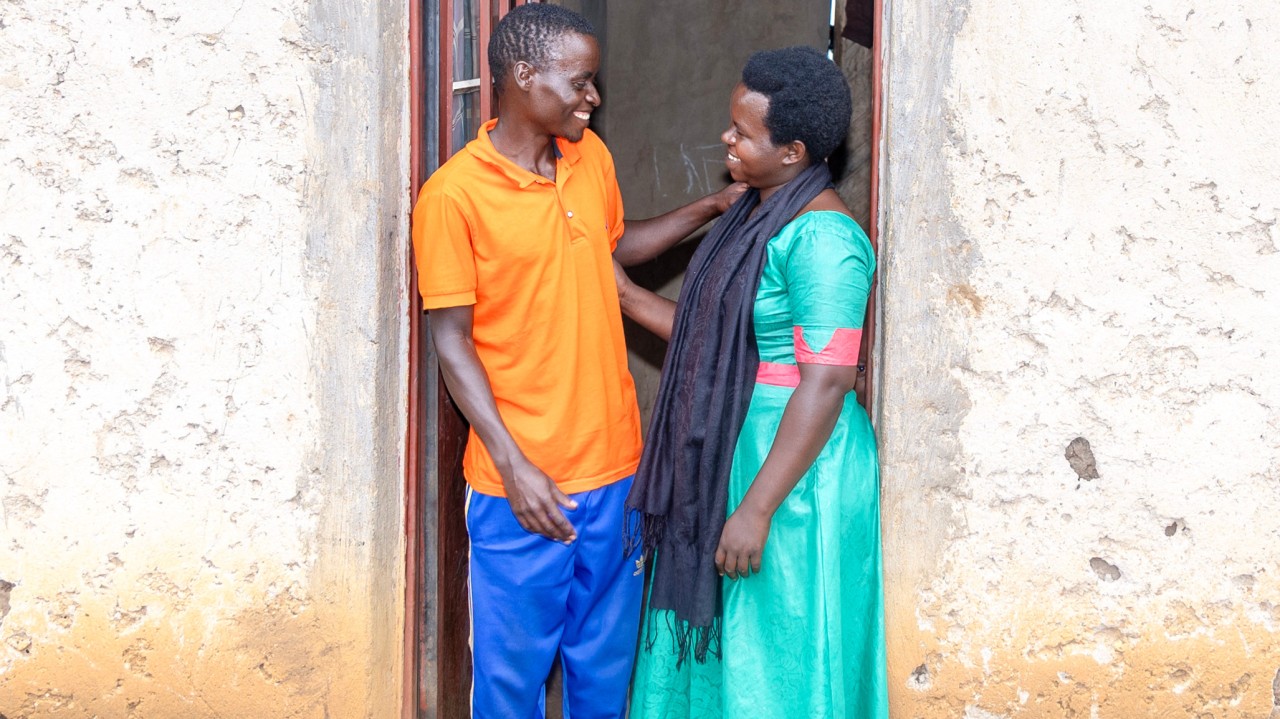
Today, their home tells a different story. Nyandwi and Regina work as teams. They plan harvests together, budget for family needs, and even install solar energy in their home. “I bought health insurance for the family, and now we decide together what to buy,” Nyandwi proudly shares. He also reduced his drinking: “Before, I would spend around 10,000 RWF a day in bars. Now I buy one bottle at home and save the rest for family needs.”
Regina feels safe and valued. “He is listening to me now. We share responsibilities. When I’m cooking, he helps with chores or studies with children. I feel supported.” Emotional healing is profound. “Before, I wished he wouldn’t come home. Now, I miss him when he’s away,” she says.
To cement their family’s healing and transformation, one significant step remained. Though they lived together, they were not legally married. This poses a risk to women specifically, when women are not legally married, they often lack access to property rights, credit, and legal protections, leaving them vulnerable to social and economic shock, especially if the relationship ends or their partner passes away.
Marking the profound change, Nyandwi proposed legal marriage to Regine. “This was a gesture from me to prove to my wife that I have changed and that I was doing it for good,” he says. For Regina, this was overwhelming. “He used to call me names, but now he says, ‘Let’s legally marry.’ Today, she proudly says, “I’m no longer an outcast. I’m a wife with respect.”
Their story is a powerful example of how changing harmful norms can rebuild broken relationships. Through the GEAR project, 600 couples have benefited in many ways as Nyandwi and Regina turned conflict into collaboration and proving that equality strengthens families. Regina hopes others will follow: “I wish all couples could join this program. It would make our communities peaceful and happy.”